 Add to Chrome
 Add to Firefox
 Add to Edge
DeGRe: Dense-supervised Generative Reranking for Recommendation
May 25, 2026
In multi-stage recommender systems, reranking optimizes overall utility by capturing intra-list contextual dependencies, yet its central challenge lies in exploring optimal sequences within an exponentially large permutation space. Recent studies have shifted towards end-to-end generative frameworks, which typically leverage list-wise rewards or preference alignment to guide generator training. However, these methods still face two critical issues. First is the heuristic label bias. Existing methods often construct training targets based on simple rules, such as promoting clicked items to the top, while ignoring causal dependencies within the list context. Second is the credit assignment problem. Sparse list-level posterior rewards fail to directly guide intermediate steps in sequence generation, leading to ambiguous optimization directions. To address these issues, we propose DeGRe (Dense-supervised Generative Reranking), a generative reranking framework that bridges the gap between offline exploration and online efficiency through dense supervision. The core of DeGRe lies in its offline-online decoupled design. During the offline phase, we introduce a Lookahead Evaluator based on cumulative regression, which leverages beam search to actively mine high-value lookahead sequences in the unexposed space. During training, we transform the step-wise value estimations from the evaluator into dense supervision signals and distill them into a lightweight Online Generator. This mechanism enables the generator to internalize lookahead planning capabilities, requiring only a single efficient greedy decoding pass during online inference to approximate the global optimum. Experiments demonstrate that DeGRe outperforms baseline models on public benchmarks and industrial datasets. We have successfully deployed DeGRe on Taobao Flash Shopping, significantly improving online recommendations.

Anchor Forcing: Anchor Memory and Tri-Region RoPE for Interactive Streaming Video Diffusion
Mar 12, 2026Interactive long video generation requires prompt switching to introduce new subjects or events, while maintaining perceptual fidelity and coherent motion over extended horizons. Recent distilled streaming video diffusion models reuse a rolling KV cache for long-range generation, enabling prompt-switch interaction through re-cache at each switch. However, existing streaming methods still exhibit progressive quality degradation and weakened motion dynamics. We identify two failure modes specific to interactive streaming generation: (i) at each prompt switch, current cache maintenance cannot simultaneously retain KV-based semantic context and recent latent cues, resulting in weak boundary conditioning and reduced perceptual quality; and (ii) during distillation, unbounded time indexing induces a positional distribution shift from the pretrained backbone's bounded RoPE regime, weakening pretrained motion priors and long-horizon motion retention. To address these issues, we propose \textbf{Anchor Forcing}, a cache-centric framework with two designs. First, an anchor-guided re-cache mechanism stores KV states in anchor caches and warm-starts re-cache from these anchors at each prompt switch, reducing post-switch evidence loss and stabilizing perceptual quality. Second, a tri-region RoPE with region-specific reference origins, together with RoPE re-alignment distillation, reconciles unbounded streaming indices with the pretrained RoPE regime to better retain motion priors. Experiments on long videos show that our method improves perceptual quality and motion metrics over prior streaming baselines in interactive settings. Project page: https://github.com/vivoCameraResearch/Anchor-Forcing
RePO: Bridging On-Policy Learning and Off-Policy Knowledge through Rephrasing Policy Optimization
Feb 11, 2026Aligning large language models (LLMs) on domain-specific data remains a fundamental challenge. Supervised fine-tuning (SFT) offers a straightforward way to inject domain knowledge but often degrades the model's generality. In contrast, on-policy reinforcement learning (RL) preserves generality but fails to effectively assimilate hard samples that exceed the model's current reasoning level. Recent off-policy RL attempts improve hard sample utilization, yet they suffer from severe training instability due to the forced distribution shift toward off-policy knowledge. To reconcile effective off-policy knowledge absorption with the stability of on-policy RL, we propose Rephrasing Policy Optimization (RePO). In RePO, the policy model is prompted to first comprehend off-policy knowledge and then rephrase it into trajectories that conform to its own stylistic and parametric distribution. RePO dynamically replaces low-reward rollouts with these rephrased, high-quality trajectories. This strategy guides the model toward correct reasoning paths while strictly preserving on-policy training dynamics. Experiments on several benchmarks demonstrate that RePO improves hard-sample utilization and outperforms existing baselines, achieving state-of-the-art performance.
SNR-Edit: Structure-Aware Noise Rectification for Inversion-Free Flow-Based Editing
Jan 27, 2026Inversion-free image editing using flow-based generative models challenges the prevailing inversion-based pipelines. However, existing approaches rely on fixed Gaussian noise to construct the source trajectory, leading to biased trajectory dynamics and causing structural degradation or quality loss. To address this, we introduce SNR-Edit, a training-free framework achieving faithful Latent Trajectory Correction via adaptive noise control. Mechanistically, SNR-Edit uses structure-aware noise rectification to inject segmentation constraints into the initial noise, anchoring the stochastic component of the source trajectory to the real image's implicit inversion position and reducing trajectory drift during source--target transport. This lightweight modification yields smoother latent trajectories and ensures high-fidelity structural preservation without requiring model tuning or inversion. Across SD3 and FLUX, evaluations on PIE-Bench and SNR-Bench show that SNR-Edit delivers performance on pixel-level metrics and VLM-based scoring, while adding only about 1s overhead per image.
PhyRPR: Training-Free Physics-Constrained Video Generation
Jan 14, 2026Recent diffusion-based video generation models can synthesize visually plausible videos, yet they often struggle to satisfy physical constraints. A key reason is that most existing approaches remain single-stage: they entangle high-level physical understanding with low-level visual synthesis, making it hard to generate content that require explicit physical reasoning. To address this limitation, we propose a training-free three-stage pipeline,\textit{PhyRPR}:\textit{Phy\uline{R}eason}--\textit{Phy\uline{P}lan}--\textit{Phy\uline{R}efine}, which decouples physical understanding from visual synthesis. Specifically, \textit{PhyReason} uses a large multimodal model for physical state reasoning and an image generator for keyframe synthesis; \textit{PhyPlan} deterministically synthesizes a controllable coarse motion scaffold; and \textit{PhyRefine} injects this scaffold into diffusion sampling via a latent fusion strategy to refine appearance while preserving the planned dynamics. This staged design enables explicit physical control during generation. Extensive experiments under physics constraints show that our method consistently improves physical plausibility and motion controllability.
ThinkRL-Edit: Thinking in Reinforcement Learning for Reasoning-Centric Image Editing
Jan 06, 2026Instruction-driven image editing with unified multimodal generative models has advanced rapidly, yet their underlying visual reasoning remains limited, leading to suboptimal performance on reasoning-centric edits. Reinforcement learning (RL) has been investigated for improving the quality of image editing, but it faces three key challenges: (1) limited reasoning exploration confined to denoising stochasticity, (2) biased reward fusion, and (3) unstable VLM-based instruction rewards. In this work, we propose ThinkRL-Edit, a reasoning-centric RL framework that decouples visual reasoning from image synthesis and expands reasoning exploration beyond denoising. To the end, we introduce Chain-of-Thought (CoT)-based reasoning sampling with planning and reflection stages prior to generation in online sampling, compelling the model to explore multiple semantic hypotheses and validate their plausibility before committing to a visual outcome. To avoid the failures of weighted aggregation, we propose an unbiased chain preference grouping strategy across multiple reward dimensions. Moreover, we replace interval-based VLM scores with a binary checklist, yielding more precise, lower-variance, and interpretable rewards for complex reasoning. Experiments show our method significantly outperforms prior work on reasoning-centric image editing, producing instruction-faithful, visually coherent, and semantically grounded edits.
Any-to-Bokeh: One-Step Video Bokeh via Multi-Plane Image Guided Diffusion
May 27, 2025Recent advances in diffusion based editing models have enabled realistic camera simulation and image-based bokeh, but video bokeh remains largely unexplored. Existing video editing models cannot explicitly control focus planes or adjust bokeh intensity, limiting their applicability for controllable optical effects. Moreover, naively extending image-based bokeh methods to video often results in temporal flickering and unsatisfactory edge blur transitions due to the lack of temporal modeling and generalization capability. To address these challenges, we propose a novel one-step video bokeh framework that converts arbitrary input videos into temporally coherent, depth-aware bokeh effects. Our method leverages a multi-plane image (MPI) representation constructed through a progressively widening depth sampling function, providing explicit geometric guidance for depth-dependent blur synthesis. By conditioning a single-step video diffusion model on MPI layers and utilizing the strong 3D priors from pre-trained models such as Stable Video Diffusion, our approach achieves realistic and consistent bokeh effects across diverse scenes. Additionally, we introduce a progressive training strategy to enhance temporal consistency, depth robustness, and detail preservation. Extensive experiments demonstrate that our method produces high-quality, controllable bokeh effects and achieves state-of-the-art performance on multiple evaluation benchmarks.
SUDO: Enhancing Text-to-Image Diffusion Models with Self-Supervised Direct Preference Optimization
Apr 20, 2025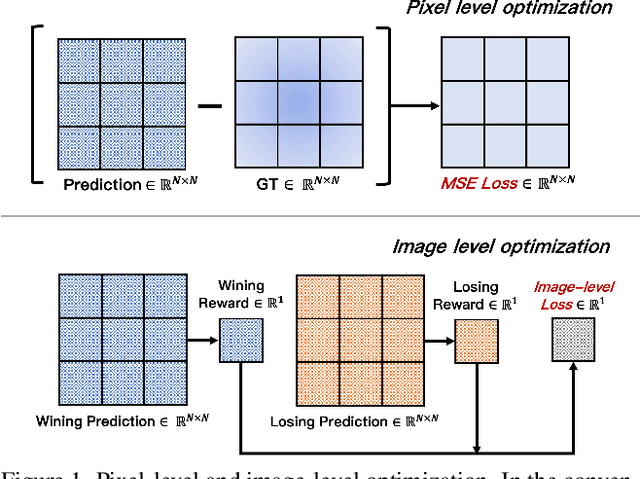
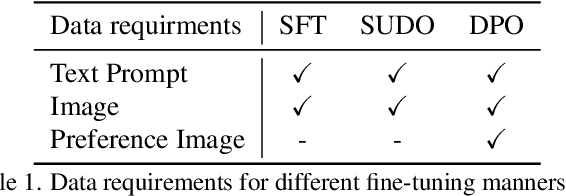
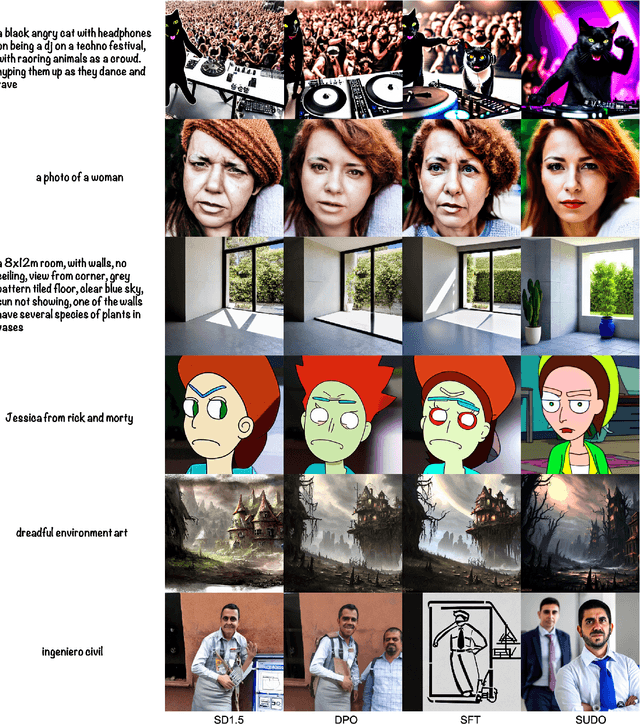
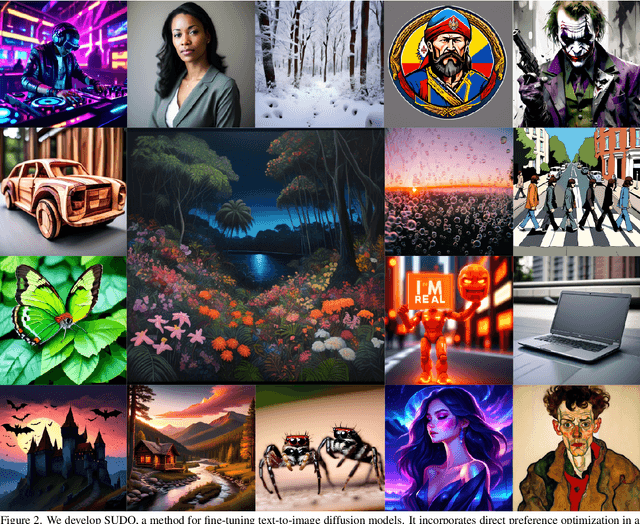
Previous text-to-image diffusion models typically employ supervised fine-tuning (SFT) to enhance pre-trained base models. However, this approach primarily minimizes the loss of mean squared error (MSE) at the pixel level, neglecting the need for global optimization at the image level, which is crucial for achieving high perceptual quality and structural coherence. In this paper, we introduce Self-sUpervised Direct preference Optimization (SUDO), a novel paradigm that optimizes both fine-grained details at the pixel level and global image quality. By integrating direct preference optimization into the model, SUDO generates preference image pairs in a self-supervised manner, enabling the model to prioritize global-level learning while complementing the pixel-level MSE loss. As an effective alternative to supervised fine-tuning, SUDO can be seamlessly applied to any text-to-image diffusion model. Importantly, it eliminates the need for costly data collection and annotation efforts typically associated with traditional direct preference optimization methods. Through extensive experiments on widely-used models, including Stable Diffusion 1.5 and XL, we demonstrate that SUDO significantly enhances both global and local image quality. The codes are provided at \href{https://github.com/SPengLiang/SUDO}{this link}.
Discriminator-Free Direct Preference Optimization for Video Diffusion
Apr 11, 2025Direct Preference Optimization (DPO), which aligns models with human preferences through win/lose data pairs, has achieved remarkable success in language and image generation. However, applying DPO to video diffusion models faces critical challenges: (1) Data inefficiency. Generating thousands of videos per DPO iteration incurs prohibitive costs; (2) Evaluation uncertainty. Human annotations suffer from subjective bias, and automated discriminators fail to detect subtle temporal artifacts like flickering or motion incoherence. To address these, we propose a discriminator-free video DPO framework that: (1) Uses original real videos as win cases and their edited versions (e.g., reversed, shuffled, or noise-corrupted clips) as lose cases; (2) Trains video diffusion models to distinguish and avoid artifacts introduced by editing. This approach eliminates the need for costly synthetic video comparisons, provides unambiguous quality signals, and enables unlimited training data expansion through simple editing operations. We theoretically prove the framework's effectiveness even when real videos and model-generated videos follow different distributions. Experiments on CogVideoX demonstrate the efficiency of the proposed method.
MagicID: Hybrid Preference Optimization for ID-Consistent and Dynamic-Preserved Video Customization
Mar 16, 2025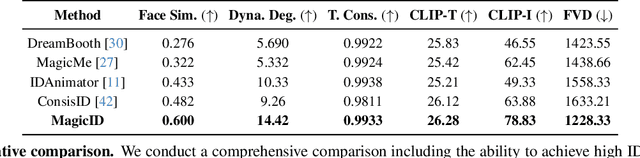
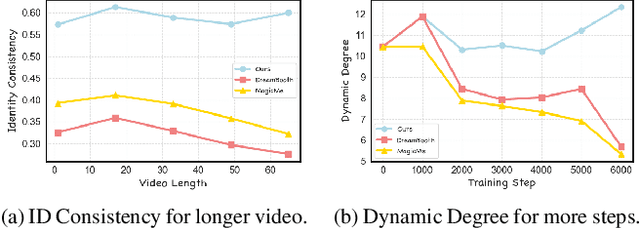
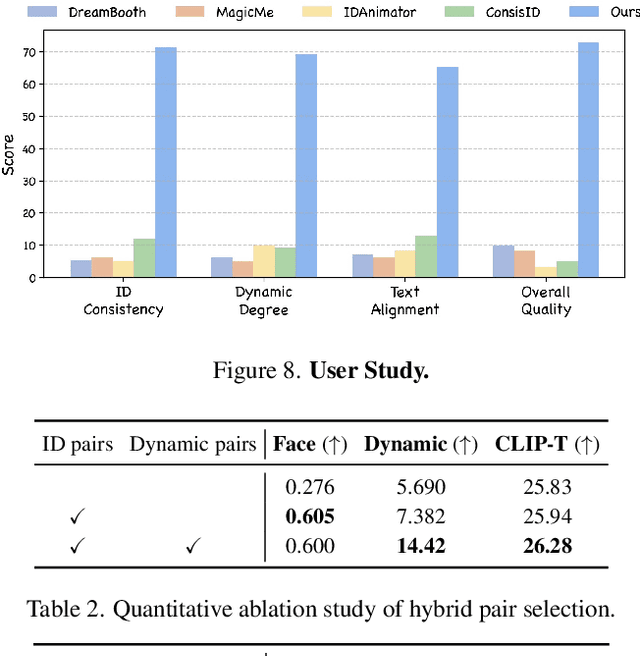
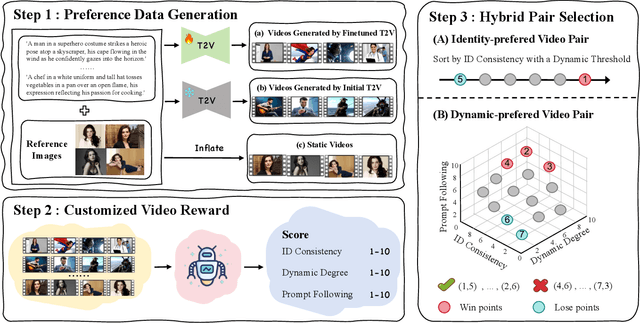
Video identity customization seeks to produce high-fidelity videos that maintain consistent identity and exhibit significant dynamics based on users' reference images. However, existing approaches face two key challenges: identity degradation over extended video length and reduced dynamics during training, primarily due to their reliance on traditional self-reconstruction training with static images. To address these issues, we introduce $\textbf{MagicID}$, a novel framework designed to directly promote the generation of identity-consistent and dynamically rich videos tailored to user preferences. Specifically, we propose constructing pairwise preference video data with explicit identity and dynamic rewards for preference learning, instead of sticking to the traditional self-reconstruction. To address the constraints of customized preference data, we introduce a hybrid sampling strategy. This approach first prioritizes identity preservation by leveraging static videos derived from reference images, then enhances dynamic motion quality in the generated videos using a Frontier-based sampling method. By utilizing these hybrid preference pairs, we optimize the model to align with the reward differences between pairs of customized preferences. Extensive experiments show that MagicID successfully achieves consistent identity and natural dynamics, surpassing existing methods across various metrics.